Anthropic Launches MHS to Let AI Agents Control Real Lab and Factory Equipment
Tests at quantum, biotech, and imaging labs show faster integration: where AI still needs humans
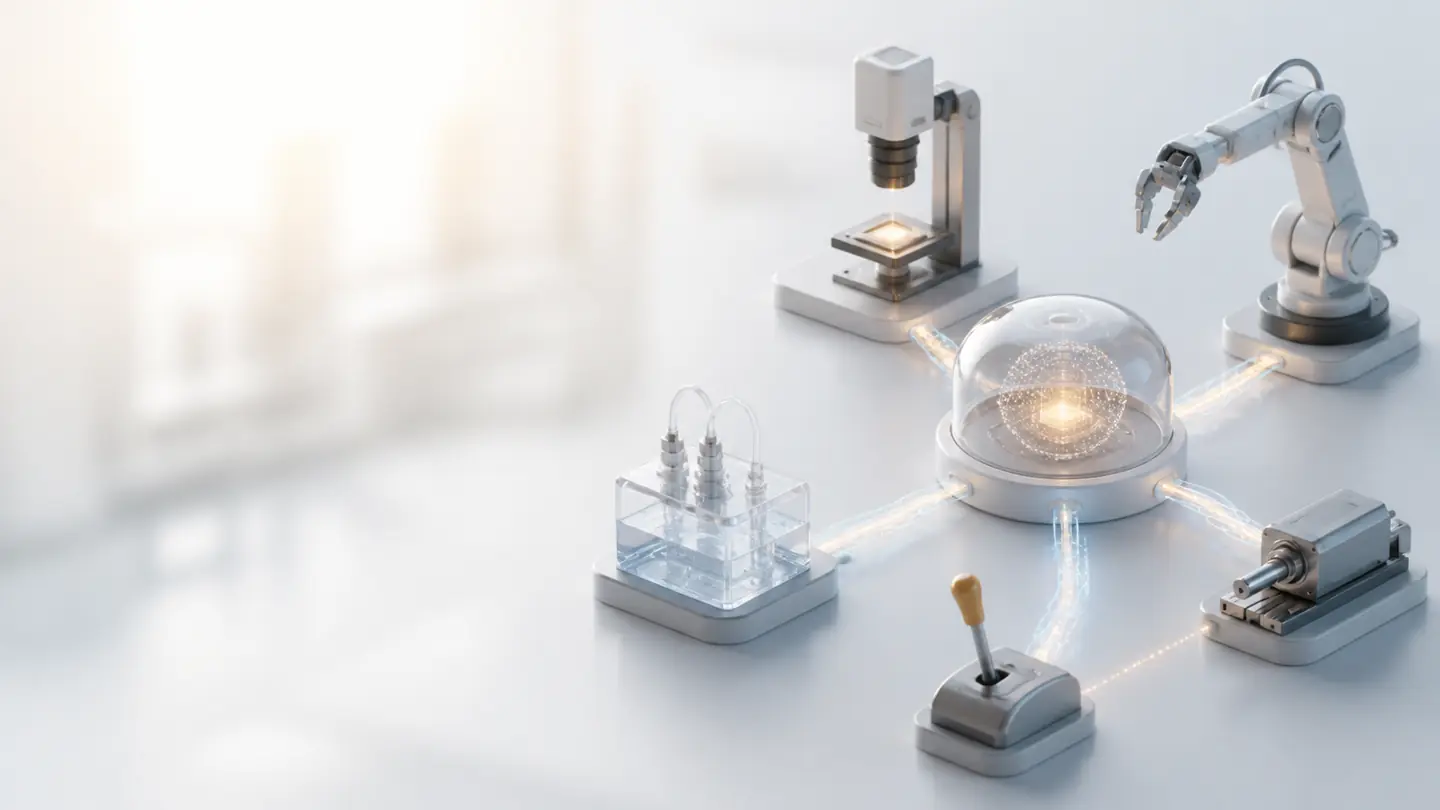
Anthropic on Thursday opened a research preview of the Model Hardware Standard (MHS), a specification that gives AI agents a common interface for operating physical laboratory and manufacturing equipment — including microscopes, liquid handlers, robotic arms, and quantum laser systems — without requiring custom integration software for each device. The launch marks Anthropic's first explicit move into physical AI, extending the same architectural logic that drove adoption of its 2024 Model Context Protocol from the software domain into the hardware world. Five partner institutions, including Genentech and quantum computing company QuEra, have already used the standard in controlled experiments and reported concrete productivity improvements — alongside a clearer picture of where today's AI models still fall short when physical reality produces unexpected results.
Read more: Claude Code's SendFeedback Tool Lets AI Draft Its Own Session Failure Reports
Why Hardware Integration Has Always Been the Bottleneck
Setting up a multi-device automated laboratory has traditionally been an engineering project measured in months, not days. Each instrument — a liquid handler from one vendor, a robotic arm from a second, a plate reader from a third — ships with its own proprietary programming interface, its own data format, and often its own programming language. Getting those devices to communicate, let alone to pass data to an AI model that can act on it, has historically required specialist automation engineers to write bespoke translation scripts for every pairwise combination of instruments. A PhD student at the University of Washington's Baker lab described the situation in Anthropic's documentation: "a typical factory line might run one protocol 10,000 times, but my lab runs dozens of protocols a year, half of them new." Connecting six instruments to a single orchestration layer previously consumed weeks, with vendor support calls and custom glue code for every device.
MHS addresses the integration problem at the driver level rather than the protocol level. Each device exposes an MHS driver — a software layer that translates the device's native interface into a standard vocabulary of "read" and "write" primitives. A command like "get temperature" or "set temperature" is expressed in a form that any AI agent can generate without knowing how the device's underlying API is structured. Crucially, the driver also encodes machine characteristics — the weight of a robotic arm, its maximum speed, its collision boundaries — in natural-language tags that an AI agent can read and reason about, making it possible for the agent to operate equipment it has never encountered before without consulting a paper manual.
Once devices are described in this way and made discoverable across a local network, an AI agent can query which instruments are available, read their current states, issue commands, and receive telemetry — all through the same interface, regardless of vendor. A shared memory state dictionary, an architecture developed at HHMI Janelia Research Campus by postdoctoral scientist Arco Bast for his brain-imaging rig, stores all device states simultaneously in a region of memory that every connected program can read without a point-to-point integration between them. The result, according to Anthropic's launch post, is that adding a new camera to a microscopy setup can drop from a multi-day engineering project to a few minutes.
For longer-running tasks where continuous agent reasoning would be too slow or too expensive, MHS allows the agent to package a sequence of hardware commands into a code file — a deterministic script the devices execute autonomously without the model needing to reason at each step. This is how QuEra's laser system ultimately reached its production deployment: Claude developed a recovery controller through overnight iterative testing, then condensed what it learned into an inspectable Python script that runs in production without any model in the loop.
What the Partner Results Actually Show
The most technically substantial early result comes from QuEra Computing, which builds neutral-atom quantum computers. Neutral-atom quantum machines use lasers to trap and manipulate individual atoms; the lasers must hold their frequency to roughly one part in a trillion — the equivalent of measuring the Earth-Moon distance to within the width of a human hair — to keep quantum operations functional. Environmental disturbances including temperature changes, vibration, and air-pressure shifts regularly push the laser off its target frequency, causing a "lock loss" that halts computation. A team of four engineers at QuEra spent several months building a bespoke Python script to automate recovery, yet that script succeeded only about 58% of the time and required around 150 seconds per attempt, according to Anthropic's documentation — because it automated the same linear sequence a human engineer would follow and inherited the same vulnerability: a mid-sequence disturbance forced the whole process to restart.
Claude, given access to the laser system through MHS and a goal of writing a Python recovery script that would work 100% of the time, ran a different kind of process. Rather than following a fixed sequence, it ran hundreds of induced disturbance scenarios overnight — blocking the beam, cutting power to instruments, shifting the frequency by varying amounts — and converted what it observed into a decision tree that reads instrument state first, then executes only the controls that the pattern of readings indicates are actually needed. Simple disturbances require touching only one or two controls; a human operator must work through all of them because the only way to be certain a control is correct is to check it. Claude found the shortcuts by running disturbances faster than any operator could. On a blind test of 700 randomized disturbances, the resulting script recovered the correct lock 695 times — a 99.3% success rate — with simple cases resolved in under six seconds and the hardest cases in 10 to 14 seconds, compared to 5 to 10 minutes for a human recovery. QuEra subsequently used a similar overnight loop to tune 12 interdependent PID parameters inside the servo loop that holds the lock quality, reducing residual noise from 15.7 mV to 1.55 mV — roughly 10 times quieter — while the laser held the lock for a continuous 19-hour test period without a single loss.
At Genentech, researchers used MHS to automate the bicinchoninic acid (BCA) protein assay, a standard procedure that measures total protein concentration by coordinating a liquid handler, a robotic arm, and a microplate reader. The challenge is fluid dynamics: aqueous solutions and viscous protein samples like bovine serum albumin behave differently under the pipetting pressures that liquid handlers use, and the optimal flow rate for each must be established before results are reliable. Claude independently executed trial transfers using a dyed liquid, read absorbance from the plate reader to evaluate accuracy, compared its results against an expert-performed ground-truth transfer, and iterated until it converged on flow rates of approximately 140 µL/s for water and 10 µL/s for BSA — parameters that Genentech automation specialists confirmed as correct. That optimization process, which ordinarily requires an automation specialist to write custom logic for every parameter set, ran autonomously. Claude also recovered from tip pickup failures and fluid detection errors without human intervention.
At Carnegie Mellon University, researchers used MHS to run serial dilution dose-response experiments — a key step in determining drug candidate dosages — roughly three times faster than before, with an AI agent orchestrating four instruments spread across three computers running three fundamentally incompatible control software environments. One of those instruments, a plate reader, had no API at all; MHS drove its graphical interface the same way a person would. When the agent found that its first dilution run produced a saturation artifact (R² below 0.9), it independently discarded the plate, adjusted the concentration range, and reran the experiment on a fresh plate, producing a strong and usable result (R² above 0.98) without any human input. Integration time for the complete four-instrument system: eight hours, versus the several weeks a vendor-supplied automated setup typically requires.
HHMI Janelia researcher Virginie Ruetten, studying how sleep affects zebrafish physiology using two-photon microscopy, unified an experimental rig that previously required seven separate vendor programs — launched in a fixed sequence, each unaware of what the others were doing — into a single MHS interface. Starting an experiment dropped from a seven-step manual launch sequence to a single click on the MHS dashboard. Anthropic also reports that an earlier HHMI imaging experiment was compressed from a multi-week timeline to a single day using MHS-coordinated hardware, though the detailed case study focuses on the interface integration rather than that specific timeline comparison.
The Standardization Play: MHS as the MCP for Physical Hardware
The strategic logic of MHS becomes clearer when placed alongside MCP, the software-domain protocol Anthropic open-sourced in November 2024. MCP addressed the N×M integration problem in the software world: before it, connecting an AI model to n different data sources or software tools required n separate custom connectors; MCP provided a universal interface that reduced that to 1×M. Within roughly 18 months, MCP had become a de facto standard across the AI development ecosystem, with major databases, developer tools, and enterprise software providers shipping MCP support.
MHS applies the same architectural argument to physical hardware. Elizabeth Kelly, Anthropic's head of beneficial deployments, told CNBC at launch that the company had built MHS "for science to sort of show the promise of AI, but there's also huge benefits here for enterprise and for industry." The standard is explicitly model-agnostic — it uses MCP itself as one of three control pathways, alongside command-line interfaces and code files, meaning no agent is required to use Claude to benefit from MHS. That model-agnosticism mirrors MCP's design and is almost certainly deliberate: a standard that requires Claude would invite parallel competing standards; a neutral open standard invites adoption.
Anthropic has already recruited hardware manufacturers into the research preview and has announced plans to open-source MHS once the preview produces adequate safety evaluations. Companies including Tecan, QIAGEN, Danaher, Universal Robots, Doosan Robotics, and AWS (through its Strands Robots library) are actively building MHS driver support into their products. When a hardware manufacturer builds an MHS driver, it is adopting Anthropic's specification — the same dynamic that made MCP the canonical software-AI interface. For Anthropic, the value is not primarily the licensing or the product but the architectural influence: if MHS becomes the standard interface through which AI agents reach physical devices, Anthropic will have defined the lowest layer of physical-AI interoperability.
Read more: Anthropic Targets Record IPO as Claude Revenue Surpasses $65 Billion
Where the Physical Intuition Gap Still Stops Claude
The research preview launch is structured as a safety-first collaboration partly because the Genentech and QuEra results expose a structural limitation that benchmark scores do not capture. When Genentech's experiment produced bubbles in a protein solution during mixing, Claude's default response was to retry the operation in the same well with varied parameters. Retrying only agitated the liquid further and worsened the foam. Claude did not model the physics of the failure: that bubbles form when a viscous fluid is mixed too aggressively, that the correct recovery requires moving to a clean well and reducing the mixing cycle count, and that this is not a software error but a fluid dynamics problem. Genentech researchers had to supply that interpretation; once they did, Claude incorporated it for the rest of the run and Anthropic subsequently codified the learning into reusable liquid-handling skills for future deployments.
The QuEra team encountered a different manifestation of the same gap. Claude "often stopped to wait for human confirmation before performing an action it deemed even slightly risky," the case study notes — which is the correct behavior from a safety standpoint but means that overnight experimental runs could pause for hours awaiting a response that a human operator wouldn't have considered necessary. The agent's understanding of the rig was, in its own words, "programmatic rather than physical": it knew what commands the instruments accepted but not how they would behave under conditions outside its experience.
This gap between logical reasoning and physical intuition is the primary technical boundary separating current AI agents from fully autonomous laboratory operation. Claude can read parameters, build decision trees from observed patterns, and write deterministic scripts — capabilities that already deliver measurable value in the results above. What it cannot do, without human guidance, is infer the physical cause of an unexpected failure from first principles: why a liquid foams, how a pressure change propagates through an optical system, or what a particular pattern of sensor noise means about the mechanical condition of an instrument. Anthropic acknowledges this directly in the launch post: "as a large language model, Claude learns about the physical world through text and images, meaning its spatial and physical reasoning have limitations that still require expert oversight."
Legacy Hardware, Cost, and the Regulatory Vacuum
Three constraints bound MHS's near-term reach in ways that laboratory publicity photos tend not to show.
The first is hardware compatibility. MHS works only with devices that have a programmable interface — an API, SDK, or operable GUI. Large fractions of the research instrument base, particularly in academic settings, are legacy devices with no programmable API. Anthropic is working with manufacturers to add MHS drivers to future product generations, but that does not help the installed base of instruments already in use. For labs that cannot afford to replace working equipment, the integration advantage of MHS does not apply.
The second is compute cost. Running an AI agent as a continuous laboratory supervisor — querying instruments, receiving state updates, reasoning about results, issuing adjusted commands — requires ongoing API calls that generate ongoing cost. The University of Washington case study explicitly flags this: "Running an agent continuously over long monitoring windows also has compute costs that need to be weighed against the researcher time saved." For large pharmaceutical labs with substantial automation budgets, this tradeoff may be favorable immediately. For underfunded academic labs where the productivity gains are potentially most transformative, the cost structure may be prohibitive at scale.
The third is the absence of any regulatory framework for AI-directed physical equipment. MHS configuration files specify safety limits — maximum robot arm speed, temperature ceilings, operational envelopes — that the driver enforces. But if those files are written incorrectly, or if an AI agent issues commands that individually stay within limits but collectively produce unsafe states, the question of who bears liability is completely unresolved. No current legislation addresses AI-to-hardware control standards specifically. Anthropic is developing what it calls a "physical safety roadmap," to be published before MHS is open-sourced, but the preview period itself operates under guidance that is still being developed.
What the Open-Source Timeline Changes
Anthropic's MCP was released as open source from day one and reached broad adoption within 18 months. MHS is launching as a closed research preview, with open-source release deferred until Anthropic and its partners have established safety evaluations and best practices for AI-directed physical equipment. That sequencing reflects a meaningful difference in risk profile: a software tool that misbehaves corrupts data or produces wrong output; a physical hardware controller that misbehaves can damage equipment, ruin irreplaceable experimental samples, or injure people.
Once the standard is open-sourced, any hardware manufacturer can implement an MHS driver, and any AI model or agent framework can use it. The research preview's true deliverable is therefore less the technology than the safety documentation and evaluation methodology that will accompany the open-source release — the set of tests, limits, and governance structures that allow organizations in regulated industries like pharmaceutical manufacturing to deploy MHS in production environments with confidence about its failure modes.
Agentic AI has spent the past two years demonstrating that models can plan, code, and use software tools with increasing reliability. The question MHS is designed to answer is whether those same capabilities transfer cleanly to the physical layer — and the first results suggest the answer is "partly, and usefully, but not without a human who understands the physics." Whether that gap narrows faster in model capability, in the accumulation of physics-aware training data, or in the development of purpose-built world models will determine how quickly the autonomous laboratory moves from a compelling research preview to a deployed operational reality.